Sunday, January 18, 2009
Cookery Book Review: Claudia Roden's The New Book of Middle Eastern Food
 In recent years there has been a proliferation of cookery books that focus on the general geographic region of the Middle East and Turkey. Fortunately, these texts have proven to the interested cook (and chef, I should imagine) that there is more to the cuisines of these cultures than kebobs, Circassian chicken, moussaka, and baklava - not that these aren't wonderful when perfectly prepared, but their ubiquity undermines the culinary variety of these interesting and vast territories.
My personal enjoyment for Turkish food began over ten years ago when my friends and I, fresh out of high school, went to the Turkish Cafe in Ponsonby (one of Auckland's restaurant rows) on a whim and hungry for something "different." Exotic to us, then, was Turkish food - and belly-dancers, but they do not an authentic Turkish meal make. Anyway, like most initiates, I tried hummus and doner kebabs for the first time, followed by baklava and syrupy Turkish coffee. Everything felt velvety on my tongue. Though simply presented, it was the luxury provided by the textural qualities of the food that won me over. I became obsessed with the restaurant for a couple of years.
If we are to talk about Turkish food in the over-arching, umbrella-sense of the culinary ideal, it is useful to know that it draws from many regional influences. The Osmanlis (Ottomans), the greatest of all Turkish dynasties, adapted Persian and Arab dishes in addition to those of the region Bolu, where the Osmanlis used to hunt, and from where the greatest cooks of the Ottoman Court were sought. Aspects of what became Ottoman and consequently a national cuisine left their mark wherever the Ottomans reigned, which speaks to the myriad versions of hummus and baklava throughout North Africa, Southern Europe and the Middle East. Historical information pertaining to cultural and sociological insights form the narrative depth from which spring the recipes of Claudia Roden's grand cookery text The New Book of Middle Eastern Food, which celebrated its 40th year in publication last year (first published by Penguin in 1968 as The Book of Middle Eastern Food).
(Please note that the concept Middle Eastern herein refers not to a specific region but to an extensive community of various cultures that have traded and shared with each other, sometimes by force or lack of choice (territory wars, dispersed populations, etc.)
In order to cook anything from The New Book of Middle Eastern Food, one should become acquainted with the various ingredients that are predominant. After an engaging introduction on the genesis and scope of her text, Ms. Roden provides the reader with information on the necessary flavourings, aromatics and condiments of Middle Eastern cookery, most of which are relatively easy to source in any large metropolitan centre, in any area where there is a distinct Arab, Iranian or Muslim community, or online, if all else fails. Such examples are: dibbs, a date syrup that is used as a natural sweetener in Iraq; orange-blossom water; pomegranate syrup (or pomegranate molasses), a dark, tart flavouring that I cannot do without; ras-el-hanout ("top of the shelf"), a spice mixture that can contain anything between 12 and 100 ingredients; and argan oil, from a nut native to Morocco.
Recipes are presented in chapters devised according to: Appetizers (Entrées for those outside of the US), Salads, and Cold Vegetables; Yogurt; Savoury Pies; Soups; Egg Dishes; Fish and Seafood; Poultry; Meat Dishes; Vegetables; Rice; Bulgur, Couscous, and Pasta; Breads; Desserts, Pastries, and Sweetmeats; Pickles and Preserves; and Drinks and Sherbets. I will touch on some of these chapters in this review.
The first food chapter, Appetizers, Salads, and Cold Vegetables, presents "an art of living," which most of us love: mezze. The perfect mezze plate comprises small bites of varying textures and temperatures. Those which inundate supposed-Occidental images of Middle Eastern mezze are well-represented here: hummus, dukkah, taramosalata, and baba ghanouj. My proclivity is towards those with Syrian accents, as indicated by the presence of pomegranate molasses in muhammara (a condiment also made with walnuts, garlic and coriander) and Betingan bel Dibs Rumman (in which pomegranate molasses plays a principal role in the marinade for baby aubergines). Common ingredients across the board are: chickpeas, aubergines, tahini (a paste made of ground sesame seeds), walnuts, and peppers. Parsley seems to be the primary herb used, and popular spices include sumac, cumin, and turmeric.
For the uninitiated, soup is a good entry into any cuisine, for the comfort of a soup bowl is seemingly universal. This may help overcome the reluctance to try something different - or at least it works when I try to get those of shy palates to challenge their tastebuds. Many a Middle Eastern soup is tangy (due to the reliance on good, sharp lemon juice), such as the Egyptian hamod and Greek avgolemono, and most rely on lentils or vegetables (particularly pumpkin and spinach) to create density in the soups. Another popular ingredient is yogurt, which is generally added after the simmering period; it adds depth and creaminess while rounding out intense flavours in a healthful way. Of all the yogurt soups, I particularly like Eshkeneh Shirazi, a specialty from the Iranian city of Shiraz (a city of gardens and fruit trees in which the oldest sample of wine has been found) to which chicken stock is added to a roux, then it is seasoned and brought to the boil before adding chopped walnuts and dried fenugreek. After a simmering period, a large quantity of yogurt is added, then the soup is quickly served. Some soups are national dishes, and their presence provides great insight into the various cultures explored in The New Book of Middle Eastern Food.
I cannot count how many times I have flipped through the Poultry chapter in the years that I have owned The New Book of Middle Eastern Food. Poultry is the stand-out star for special occasions, particularly festivals. As Claudia Roden presents each recipe simply, one can serve a dish that is ordinarily grand in an accessible, mid-week way. For example, Hamam Mahshi bil Burghul is a way of expressing one's love for someone else, but it is essentially roasted and stuffed small poultry (usually poussins or chickens). We all know how to do this, and I use this particular recipe on a regular basis - the poultry marinates in an aromatic oil of cardamom, cinnamon and allspice and is stuffed with sweetly spicy and nutty bulgar wheat that is plumped up in chicken stock. Of course, I suppose, nothing says "I love you" better than a well-prepared, roasted chicken. Combining poultry with sweet ingredients (particularly cinnamon and fruit) is fairly commonplace throughout the Middle East. Fast approaches include Tabaka Piliç (Georgian chicken with plums) and Djaj bel Loz (Moroccan chicken with almonds and honey).
Meat Dishes picks up on the lavishness of the Poultry chapter, for meat was largely associated with aristocracy, and is to this day used sparingly and for special occasions in some parts of the Middle East. There are many recipes for stuffed meat, ground meat, tagines (Moroccan stews), and offal. As a lover of lamb (no surprise, I suppose, given that I am from New Zealand), this chapter is a particular favourite. Great and interesting examples of lamb dishes include: Shish Kebab (marinated, grilled meat on skewers), Kuzu Kapama (a Turkish dish for leg of lamb with scallions and herbs), and the Turkish lamb stew with creamy aubergine sauce (Hünkâr Beğendi). For those who love meatballs, there are 8 recipes in this chapter. Meatballs with spinach and hummas (Kofta bel Sabanekh wal Hummus) is popular throughout the Middle East, and I like to serve it an Iranian sauce made with orange juice (khoresh sak) - a photograph is provided at the opening of the post; the taste outshines and belies its simple appearance.
 As meat is used judiciously, there is a reliance on Vegetables, Rice, and Bulgar, Couscous, and Pasta, which make up three detailed chapters in The New Book of Middle Eastern Food. If ever you want to glamourise and vaunt a side dish of vegetables, or if you are looking for vegetables presented as a main course, look no further. In the Middle East, vegetables are grilled, stuffed, preserved and gently cooked in myriad ways. In Egypt, leeks (korrat) are added to fried garlic and caramelised sugar, sprinkled with lemon juice and salt, then stewed. One then chooses to serve them cold as an appetizer/entrée or warm as a side-dish. In Iran, spinach is given a jolt by being added to soft mixture of fried onions, turmeric, cinnamon, prunes and black-eyed peas (Aloo Sfenaj). Personally, I get giddy at the sight of all the aubergine recipes. There are directions on how to fry, broil, grill and roast them, and there are many base recipes given with regional variations. I love the Palestinian dish Ma'loubet el Betingan, in which aubergines are sliced and broiled before being presented in a layered dish. Place sweetly spiced lamb on the bottom of a frying pan, cover it with slices of broiled aubergine, which in turn is covered with rice. Repeat the process, then fill the pan with water, which is gently brought to the boil then turned down to a simmer until the rice is tender. Easy to prepare and a savoury delight, Ma'loubet el Betingan is then set off with toasted pine nuts.
Rice is given royal treatment in Iran. When served plain (chelow), it is used to fill out dishes or to accent ingredients contained in the main meal. It is elevated to a polow when combined with other ingredients in an artful manner (often with nuts and sweet, dried fruit). Many a special pilaf (rice dish) come from Iran and Turkey. One such example is Balkabagi Pilav, for which cubed pumpkin simmers in chicken stock with rice and lightly friend onion, heady cardamom and cinnamon until the rice has absorbed the chicken stock and the pumpkin is tender. Sauces are often employed to make a meal out of rice alone. These sauces (or khoresht-ha in Persian) are dramatic, for their puncutate fluffy, buttery rice with an edge of bitterness and sourness. Khoresht-e Ghormeh Sabzi is a herb sauce made with dried limes, fenugreek, and an abundance of herbs (namely, dill, parsley, cilantrao). Khoresht-e Rivas is a sauce made with tart rhubarb, softened with allspice and cinnamon, and paird with mint and parsley. Short-grain rice is used for rice puddings and stuffing vegetables.
 Bulgar, Couscous, and Pasta showcases the versatility of these Middle Eastern staples, most of which are common to many households outside the Middle East due to easily making them tasty in a short space of time. Bulgar is cracked wheat, which is to say wheat kernels that have been boiled, dried, then ground. It adds a nutty flavour to dishes and comes in three types of grind: coarse, medium and fine. It is used to make extraordinary pilafs and salads. In the days of the Ottoman Empire it was soaked in chicken stock and was combined with toasted pine nuts and raisins. Like this, bulgar could be used as a side dish or as a stuffing - I like to stuff aubergines and bell peppers with it for a quick, summery lunch. Couscous is a staple of North Africa, and it is made by grinding semolina in a coarse manner, then coating it in flour. It is usually steamed in the dishes made from it, which are often also called couscous. Used as a bed for flashy ingredients (such as almonds and squab, perfumed with onions, gingner, saffron and ginger) or as an integral ingredient for a savoury stew (such as the Moroccan dish Kesksou Bidaoui bel Khodra, in which lamb stews with seven vegetables and chickpeas), couscous is a delight. The predominant pasta used in the Middle East is orzo, known in Arabic as "birds' tongues." Like bulgar, it is best flavoured by soaking up stock.
 The majority of desserts (whether they be preparations of fruit, pastries or sherbets) from the Middle East are very sweet, but they are consumed in small doses. I adore them because they are always beautifully coloured and exquisitely perfumed. If you want a show-stopper, Claudia Roden has been thorough in providing the reader with many options to deliver. If you are in the mood for fruit, a fruit salad is enlivened with rose water, orange slices are lifted with a touch of orange-blossom water, and apricots are simmered in a perfumed rose water and sugar syrup before being filled with cream and adorned with chopped pistachios (the Turkish dessert Kaymakli Kayisi Tatlisi). If you prefer ice cream, try ones made with pistachios or almonds, or even the traditional sahlab offering from Turkey, Lebanon, Syria and Egypt (made with mastic and orange-blossom water, sahlab is the ground root tuber of the orchid family that creates a chewy ice cream). There are gorgeous pastry desserts, such as baklava (layers of filo pastry interspersed with perfumed and buttered ground nuts, usually pistachios or walnuts, M'hencha (a Moroccan dessert of ground, sweetly-spiced almonds, rolled up in filo, which is then spiralled into the shape of a snake before it is baked), and Ma'amoul (date-filled pastries - in Syria and Lebanon the pastry is made with semolina instead of flour). You will now have an idea of the ingredients preferred in desserts: fruit, sweetened and spiced nuts, and rose and orange-blossom waters. Ataïf are Arab pancakes, made with yeast and coated with a fragrant sugar syrup. These pancakes can also be filled with nuts and lightly fried before being dipped into the syrup (known as Ataïf bi Loz, as photographed in this paragraph).
And this is just a sampling of what The New Book of Middle Eastern Food contains. There are breads, preserves, and fish courses, too. Giving a textural quality to the recipes is a rich backdrop of history, cultural observations, riddles, and anecdotes. For the kitchen or armchair traveller, this is an ideal text. I feel like I have been to the Middle East every time I cook from or read this seminal cookery book. The cooking methods have been adapted for modern kitchens and technology, the recipes have been tested for success (though, of course, there is always room for personal interpretation and tastes), and the tone of Claudia Roden's writing is never intimidating - it is as welcoming and friendly as the lavish dishes provided in this, one of my "desert island books": The New Book of Middle Eastern Food.
(When I first began blogging, I participated in a blog event in which we were to cook from a cookery book, and I chose this one. You can read about and the chosen recipes here.)
Labels: Book Review, Claudia Roden, Middle Eastern, Turkish


Sunday, February 10, 2008
Hummas
 Not to be confused with Hummus, Hummas is a Morrocan dish of chickpeas, turmeric and parsley (or coriander, or a mixture of both). I feel that I will be spending the next month or so informing myself of Moroccan cooking. The timing could not be better, for February is often a very warm and humid month in Auckland, and what mostly appeals to me about Moroccan food is that it is spicy but not terribly hot. This post also serves two purposes, as I not only try the combination of turmeric and parsley, but I also submit it to my good friend Susan's food event, My Legume Love Affair.
Chickpeas (also known as garbanzo beans) are grown all over the world, specifically in the Mediterranean, Western Asia and throughout India. I have made good use of them as the key protein in vegetarian curries, finding that they are ultra luxurious when coated with a thick sauce. Nutritionally, there are many benefits but most interesting is that fact that chickpeas are high in folate, which is a B vitamin necessary for creating serotonin (which makes us happy and assists in liver regeneration, amongst other things, and in this respect amongst other properties, chickpeas are also similar to spinach - no wonder I feel so good after eating both!).
In Moroccan cuisine, chickpeas are used in many a dish, most importantly Harira, a soup that is eaten to break the fasting day in the month of Ramadan. Chickpeas also feature in couscous recipes, which are probably the most familiar of Moroccan cuisine.
 Turmeric is part of the ginger family, and its rhizomes are boiled and then dried in ovens before being ground into the marigold-coloured spice with which we are familiar. It is incredibly aromatic and has a mildly bitter, peppery flavour and smells like mustard. Often it is used as a colouring agent in food, but in this recipe, it not only imparts its gorgeous colouring, it also adds warmth and plays with the sweet onions and parsley, bringing out a somewhat unexpected character...
Turmeric is the only spice in this recipe, so the freshest you can find will be best. If you are going to use dried chickpeas, they first need to be soaked overnight (actually, for any recipe, you have to soak dried chickpeas in advance of preparing them). If you are using canned chickpeas, ensure that they are drained before use.
Hummas
(from Claudia Roden's The New Book of Middle Eastern Food)
2 tablespoons vegetable oil
1 large onion, chopped
3 cloves garlic, crushed
1/2 teaspoon turmeric
1 1/2 cups chickpeas (to be soaked overnight) or 600g/21oz of canned chickpeas
salt
pepper
1 cup parsley, chopped
1) In a large pan, heat oil and fry the onion.
2) Add garlic and stir.
3) Stir in the turmeric.
4) Add chickpeas and turn them in the onion.
5) Cover with water and simmer for 15-20 minutes if using drained chickpeas from a can. If using dried chickpeas that have been soaked then drained, simmer for 1 1/4 hours.
6) Add salt and pepper only after the chickpeas have begun to soften.
7) Add water to keep chickpeas covered, if necessary.
8) Once the chickpeas are tender, reduce the liquid until it becomes a thick sauce, approximately 20 minutes over a medium heat.
9) Stir in the parsley and cook for five more minutes.
 Hummas is really what one eats when the fridge and pantry are bare, and in Morocco, it is considered a food of the poor that it is stretched by often being served with hot bread. Ms. Roden writes that this dish can be cooked using saffron instead of turmeric (and even though the two do not taste at all similar, they impart a golden colour); it can then be served as a first course. I was most surprised by the faint gingery notes because the spice smells more like mustard than it does ginger. It plays beautifully with the caramelised onions and fresh parsley, toning down the flavours of both with its warmth.

Labels: Chickpeas, Claudia Roden, Moroccan, Turmeric
Thursday, July 26, 2007
7 Random Cookery Books
 I don't know where your cookery books are, but - more often than not - my cookery books are in piles on a sofa, on a bedside table, or in the kitchen. It was with great satisfaction to put them all on the bookshelf, for my good friend, the talented and quick-witted Susan at The Well-Seasoned Cook, tagged me to participate in a meme that is meant to showcase seven randomly selected cookery books. How one randomly chooses from books piled up in two houses that are in two different countries is a bit of a problem because it eliminates some possibly whacky combinations. On the other hand, at least I don't have to get all of my cookery books into one room before randomly selecting seven of them. That presents a methodological issue anyway, for pile-making is not necessarily amenable to random selection on account of stabilising the piles by putting the largest on the bottom, thereby eliminating some books on account of where in the pile they fall. Instead of following any scientific method for random sampling (taking statistics papers at university has its upside), I went for an artistic approach. I went to the lounge, where the grand bookcase is, and just grabbed seven cookery books. I didn't really look or think - a blur of book spines passed before my eyes.
This is what I came up with:
Field Guide to Herbs and Spices by Aliza Green - A compact book that gives information on the general description of, season for, purchase information about, and storage ideas for all the herbs and spices you can think of - and then some. There are recipes, too, though not many for main courses. There are photos of the herbs and spices in their various forms and recipes for spice mixtures also. If it wasn't for this book, which my angelheart Eric came across, we would not have fallen in love with allspice and would not have made Green's recipe that features this unique spice in a vinaigry Jamaican Jerk-Spice Chicken. The information is dense and broad - if you ever wanted to make Moroccan majoun, which requires cannabis, there is a recipe for you, or if paprika is more your thing, try Ms. Green's Hazelnut Romesco Sauce. It is a handy and easy-to-use go-to book.
Sunday Suppers at Lucques: Seasonal Recipes from Market to Table by Suzanne Goin with Teri Gelber - Well, you have already seen some of my results from using this book with the Sweet Cherry Compote and the Braised Chicken with Saffron Onions. Largely informed by her Southern French proclivities, this chef creates rich and tasty dishes with seasonal Californian produce. The chapters are divided by season and the content for each is divised by menus, preceding which are details on what to look out for at farmers' markets. This book taught me how to make good use of the Long Beach and Santa Monica farmers' markets, and every time I flip through the book, there is a new recipe I want to try, like her kabocha squash and fennel soup. The menus make you feel sophisticated, but, more importantly, they teach you how to combine and highlight different flavors.
How to Eat: The Pleasures and Principles of Good Food by Nigella Lawson - This is the British cookery book that defined a generation and got the kitchen shy X-generation into the kitchen. With her gift for prose, making even the lengthiest recipe seem achievable, Ms. Lawson writes like your best friend - full of advice and tongue-in-cheek laughs, she is there for you every step of the way. This is the first cookery book my angelheart Eric and I received - from the sassy sauciere queen Lily - and the first thing I made was the 7-Minute Steamed Chocolate Pudding, which was made in a microwave (I was a kitchen virgin, after all) and taught me that not only was chocolate messy to cook with but I might actually enjoy myself in the kitchen. The next baby step I took was in the salad direction, Chestnut and Pancetta Salad. There are classic recipes, seasonal menus, tips for entertaining and pantry-filling success. If not within grasp in the kitchen, this book is found on the bedside table. A must have. Really.
Cooking School Secrets for Real World Cooks by Linda Carucci - When I first started cooking at home, I thought I had best learn some of the principles to cooking. I didn't want to burn the house down, and I didn't ever want to serve inedible food. Though recipes tell one what to do, they don't often say why one should do it. This book is packed with cooking methodologies, "recipe secrets" (such as how to make the perfect hard-cooked eggs, which cream cheese is best for cheesecakes, and how to make the perfect risotto, to name a few) and information on how to make the most of your palate, kitchen equipment, and produce. Dense and interesting reading for those with inquiring minds.
Eat This Book: Cooking with Global Fresh Flavors by Tyler Florence - I am indebted to this man for his Roasted Chicken Stuffed with Lemon and Herbs. This is the method that really works well for me and my angelheart Eric, though we have since changed the citrus and herbs out for others that we prefer and we use less oil. I know that 'roast chicken' are fighting words in the world of cooking, but this recipe is a great introduction for those who don't know how or are afraid to make one - this is indeed the very recipe I taught to my galpal, the cocktail-swilling and sparkling Sarah. Otherwise, the book features largely Chinese-inspired twists on food, with forays into the territories of Argentina, Spain, India, and Mexico, to name a few. This is the go-to book for big flavors, whether you're making sauces, spice mixtures, vegetables, poultry, meat, seafood, or dessert. Mr. Florence's Curried Cauliflower with Chickpeas and Tomatoes and Argentinian Gaucho Steak (which first introduced me and my angelheart Eric to chimichurri) are swoon-worthy.
Mexican Everyday by Rick Bayless with Deann Groen Bayless - In California, the Mexican food is great, but this book is designed to show that there is more to this cuisine than pork burritos and guacamole, though I happen to love both. Mr. Bayless' recipes constitute the great Mexican food found predominantly away from the tourist traps. There is an excellent introduction to Mexican ingredients, and his "riffs" peppered throughout the book provide good alternative methods or ingredients to his recipes. I cooked a lot from this book last Summer, particularly when my good friend, the cocktail-swilling and sparkling Sarah stayed with my angelheart Eric and I for one month - and her view of Mexican food was transformed. Mine has been, too. I have had incredible and repeated success with Sinaloan Grilled Roadside Whole Chicken with Knob Onions and Roasted Tomatillo Salsa .
The Book of Jewish Food: An Odyssey From Samarkand to New York With More Than 800 Ashkenazi and Sephardi Recipes by Claudia Roden - This book is a carefully documented text that examines various aspects of Jewish life all over the world - from history (the 'discovery' of Jews in China), to cultural insights (how gefilte fish came about), to recipes (including an account of bagels). The recipes are divided into two sections: first presenting Ashkenazi recipes, then those Sephardi. This is not a book for those who need photos, though there are black and white stills of people (as opposed to food). Ms. Roden's prose is engaging and precise, painting a better and more erudite picture than any photo could. This is the book I use for Chicken Stock and Knaidlach, and there are hundreds more incredibly interesting recipes (from Plum Soup to Lokshen Kugel to Trieste Yeast Roll) to follow. This book will expand your culinary repertoire whilst giving you superlative cultural insight.
This is a really fun meme for foodies, who are usually known for constantly reading cookery books. I have decided to pass the baton to:
Freya at Writing At the Kitchen Table
Cenk at Cafe Fernando
Jasmine at Confessions of a Cardamom Addict
Pille at Nami-nami
Sara at i like to cook
Emma at The Laughing Gastronome
Joe at Culinary in the Country
Labels: Aliza Green, Claudia Roden, Linda Carucci, Nigella Lawson, Rick Bayless, Suzanne Goin, Tyler Florence
Tuesday, April 03, 2007
Sigara Böregi
 I will not bore you with the details of my Master's research, but I will let you know that the geographic area it mostly concerns is Turkey. In addition to researching methodologies, academic approaches, and fact-finding, I am also drowning myself in the literature of Orhan Pamuk. To keep the thread laced, I wanted something simply and sublimely Turkish. Being simple was key, for I was playing in the kitchen during a study break. The parameters being set, I decided upon making little cheese cigars, which are ideal for appetizers - and I was generous enough to share.
On working with filo pastry, the key objective is to prevent it from drying out. I am a bit of a pro at this now, and I assure you that the goal is simply accomplished by resting the sheets of pastry (already cut to the desired size) one neatly stacked on top of the other, ensuring the top sheet is covered with either a damp tea towel or wet paper towels. Other than that, just work as quickly as possible.
The inclusion of herbs is optional as is the quantity. I used 4 tablespoons of parsley, but I could have used one less tablespoon, which could have equally been substituted with dill or mint, keeping with the theme of that which is Turkish. This recipe makes 16 little cheese cigars, which can easily be multiplied depending on the occasion.
Sigara Böregi
(from Claudia Roden's The New Book of Middle Eastern Food)
7 oz (approx. 200 gms) feta
1 egg, lightly beaten
3-4 tablespoons parsley, dill, or mint, finely chopped (optional)
4 sheets filo
4 tablespoons melted butter or oil
1) For the filling, mash the feta cheese with a fork and mix with the egg and the herbs, if including.
2) When ready to use them, take out the sheets of filo and cut them into 4 rectangles each, about 12" by 4" (30.5cm by 10cm), before covering with either a damp tea towel or wet paper towels.
3) Take out the top sheet of filo and brush it lightly with oil or butter.
4) Put a heaped teaspoon of the filling and place it at one of the two short ends of the rectangular sheets of filo about 1" (2.5cm) from the end.
5) Roll up the sheet like a cigar by taking the 1" (2.5cm) end over the filling and gently and tightly rolling until 1/3 of the way along the length of the sheet.
6) Turn the sides over, locking in the filling, and continue to roll until you have a little cigar.
7) Repeat until rectangular sheets of filo and filling are used up.
8) On a greased baking sheet, place the little cheese cigars close to each other and brush the tops lightly with melted butter or oil.
9) Bake at 350 F (175 C) for 30 minutes, or until crispy and golden.

Serve these flaky and salty beauties hot.
And now I'm finally off for a three-week visit to Los Angeles to be with my angelheart Eric.
Labels: Claudia Roden, Feta, Filo, Turkish
Friday, February 02, 2007
Chicken Stock and Knaidlach = Matzo Ball Soup
 You do not have to tell me - I already know that it is not Passover and that I'm not Jewish. My angelheart Eric and I have, however, been hankering for matzo ball soup since (a) our (still recent) lunch at Pitchi Poï in the fourth arrondisement in Paris, and (b) last year's Passover at which the divine poetess Suzanne's father's wife made a deliciously light soup. There is certainly a restorative positive externality to good chicken soup, which Claudia Roden calls "Jewish penicillin" because it cures all, a medicinal and spiritual reliever. Though we were not exactly feeling poorly before consuming the soup, we felt incontrovertibly better after each golden spoonful. This was partly because we were able to satisfy a craving, and also because the stock and knaidlach had been made at home.
Making chicken stock could not be easier: Boil chicken, clear scum, add veggies, then let simmer for a few hours. I would have wound up with more stock had I not forgotten the buoyant nature of the veggies and not therefore assumed the soup pot was full of liquid. I still ended up with just over two quarts, which was enough for the soup and three or so cups for future recipes that require chicken stock. Now that I have made it once, I think I should make it weekly because there is nothing like having homemade stock, for you can see what has gone into it and you know what you're adding to the recipes. And short of raising the chickens and growing the veggies myself, this tastes (in the best of possible meanings) very homegrown. (I don't mean to sound condescending, for I am not the great hero Levin of Leo Tolstoy's Anna Karenina toiling and making produce from his own land, but this brings me a step closer to understanding the romanticism with which some people view the world agrarian.)
 I turned to Claudia Roden's ground-breaking (because of the scope and research into the subject in addition to her fine writing) The Book of Jewish Food: An Odyssey from Samarkand to New York. (I often turn to Ms. Roden whether or not I'm thinking of what to make with what my angelheart Eric and I have on hand, if not for her in-depth focus but for her nourishing and informative prose. Everyone who is seriously interested in food should at least have The Book of Jewish Food and The Book of Middle Eastern Food, though I also have others of hers.) I admit to altering but a few things for the stock. I used 1 chicken carcass and 6 chicken wings where Ms. Roden suggests 1 stewing chicken weighing 5 lbs (around 2.5 kgs) or one chicken carcass and two packages of giblets weighing 1 lb (500 g). I also increased the level of liquid because I used a big pot, so that also allowed me to double the dosage of ingredients. Additionally, I added fennel because I forgot to get leeks and turnips from the market, and I used black pepper instead of white. Towards the end of the simmering period, the fennel was really coming through, and I was childishly excited about the faint, sweet trace it would leave in the soul-warming soup.
The recipe below yields 2 quarts (2 litres).
Chicken Stock
(adapted from Claudia Roden's recipe for Chicken Soup in The Book of Jewish Food)
Chicken in any of the combinations above stated (just be sure that there are bones to yield a gelatinous substance that insulates and protects the stock when frozen or left the chill and flavor; the giblets lend an "essence of chicken" flavor)
1.5 large onions, quartered
4 carrots, cut into big chunks
2 fennel bulbs, quartered
4 celery stalks, cut into big chunks
4 sprigs of parsley
salt
pepper
1) Put the chicken in a soup pot, which is filled with water.
2) Bring to a boil and remove scum.
3) Add vegetables, parsley stalks, salt, and pepper.
4) Simmer, covered, for at least 2.5 hours (I went just over 3 hours on account of the added volume, but not much over because I have a cast iron pot that retains heat really well).
5) If using a whole chicken, take it out after an hour so as not to overcook it. Remove meat from it, then add carcass to the pot.
6) Once simmered enough (again, at least 2.5 hours), strain the broth into another vessel. If you are concerned about the fat on top, soak it up with a paper towel, or make the stock (or broth if going on to make a traditional chicken soup) one day in advance, let chill in the fridge overnight and then remove congealed fat from the surface in the morning.
At this point, I put three cups into the fridge to cool completely and then freeze for future use. The remainder was left covered on the stove top while I prepared the knaidlach.
Now, there is an art to making knaidlach, and I certainly have not yet learned it. I found it was very difficult to shape the mixture into balls because it kept sticking to my palms, so I wound up using spoons, resulting in irregular shapes, akin to ovals, or, if being blunt, flat rhomboids. There is hardly anything in this mixture, which yields light and fluffy knaidlach, but one could also add chicken fat, ground almonds, beef marrow...I'll try a variation next time.
Knaidlach
(from Claudia Roden's The Book of Jewish Food)
2 eggs, separated
1/2 cup (75 g) medium matzo meal (I ground matzos in a blender)
salt
1) Beat egg whites until stiff.
2) Fold in the lightly beaten yolks, followed by the matzo meal and salt until unified.
3) Chill, covered, for 30 minutes.
4) Roll into 3/4" (2 cm) balls, if you can manage it.
5) Drop balls into plenty of boiling salted water.
6) Simmer for 20 minutes.
 Matzo Ball Soup
1) Boil desired amount of homemade chicken stock.
2) Add matzo balls, and boil for but one minute if balls are already warm (if not, reheat in the water that they were boiled in before adding to stock - they absorb a lot of liquid).
Labels: Claudia Roden, Soup
Sunday, December 03, 2006
Weekend Cookbook Challenge # 11 - Party Food
I know, I know. It has been a while since I last participated in a Weekend Cookbook Challenge (WCC), but for WCC #9 I spent so much time deciding what dish from my homeland to make that I missed the deadline, and for WCC #10 I didn't have a kitchen gadget that I hadn't used quite a bit, so I didn't even "qualify" for that one.
This is actually my second attempt to type this post because as I was doing it last night, in an effort to meet the deadline as we ate the "Party Food", my angelheart Eric knocked a stack of cookbooks off a chair ledge and they landed on the power strip! So, everything went down, and, of course, the server does not "emergency save" documents as does Windows. It was well after 10pm then, and I just decided I'd try again as soon as I got up this morning.
So, I've given away the theme to WCC #11 already: Party Food. Isn't every meal an invitation to party for us foodies? My angelheart Eric and I often host little dinner parties, wine tasting parties, and big events parties (mostly New Year's Eve), so I really wasn't sure how to tackle this month's theme. I just decided on something simple, for most of us are still full from feasting at Thanksgiving meals. The small party number went from five to three (including the hosts!). It was to be seen as a catch up over finger food, and it ended up being quite a lot to eat for 3, and we ate quite a bit of it over the course of a couple of hours. I made two types of dip, Bagna Cauda (from The Stinking Rose Restaurant Cookbook) and Muhamarra (from Claudia Roden's The New Book of Middle Eastern Food), Zucchini Frittata (it was meant to be zucchini fritters, but the batter kept sticking to the frying pan; the recipe is mostly modeled after one from Claudia Roden's fabulous Arabesque), and Brandy Creme Brulee (there is almost no need to cite a reference as I could have done this with my eyes closed, but the inspiration to add brandy came from Debbie Puente's Elegantly Easy Creme Brulee that my darling friend Lily gave to me almost two years ago). My angelheart Eric made Chicken Pieces Marinated in a Light Satay - his own recipe.
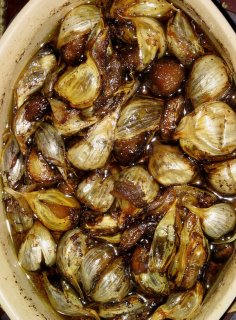 When I first moved to the U.S., my angelheart and I often had dinners with friends in Beverly Hills at The Stinking Rose, a garlic-themed restaurant. It is a high energy restaurant (on account of its lively staff and individually-themed rooms) with great food that is made consistently well (usually if I like something a lot the first time, I order it time and again). I always made sure there was bagna cauda (hot bath) on the table. I could have used Tamasin Day-Lewis' recipe from Tamasin's Weekend Food, but I wanted to recapture something from my early days in the U.S., and it has been a really long time since my angelheart and I were last at The Stinking Rose.
Bagna Cauda
(from Andrea Froncilla and Jennifer Jeffrey's The Stinking Rose Restaurant Cookbook)
2 1/2 cups garlic cloves, skins intact (about 3 heads of garlic)
2 cups olive oil
1/4 cup unsalted butter (56.5g), cut into bits
6 anchovy fillets in olive oil (the recipe calls for a whole 2oz can)
1) Preheat oven to 275 deg. f. (135 deg. c.).
2) Put garlic cloves into a baking dish (either cermaic or heavy glass is suggested, but it worked well in our pink(!) stoneware LeCreuset baking dish).
3) Pour olive oil over garlic.
4) Sprinkle butter over garlic.
5) Lay anchovy fillets in a single layer on top.
6) Cover with aluminium foil and bake until clovers are easily squishable (preferably dense and limp - approximately 1 1/2 hours).
7) To serve: Use a spoon to slot out one clove and use the back of the spoon to press out the garlic onto a slice of baguette or focaccia.
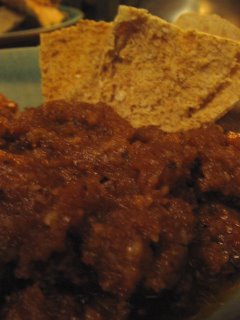 Muhammara is a walnut and pomegranate relish that is made in Turkey and Syria. Each component adds incredible depth to an all-too-simple accompaniment: the walnuts provide the nubbly texture, the pomegranate syrup gives the tart-yet-sweet high notes, while the cumin adds the smokey low-note. Served with cripsy pita bread, which we toasted in the oven after cutting into chips and sprinkling over a combination of kosher salt and flaky smoked Manuka honey sea salt.
Muhammara
(From Claudia Roden's The New Book of Middle Eastern Food)
1 1/4 cups shelled walnuts (or walnut pieces, if you can get them)
1 1/2 tablespoons tomato paste
1 slice whole-wheat bread, crusts removed, lightly toasted
1/2 cup extra-virgin olive oil
2 tablespoons pomegranate syrup
1 teaspoon coarsley ground red-pepper flakes
1 teaspoon ground cumin (I love that hit of smokiness that wafts up when milling cumin seeds with the pestle)
2 teaspoons sugar
salt, to taste
1) Blend all ingredients to a rough paste in a food processor.
That could not get any easier, and it is worth trying because it is an unusually sweet "dip" that had my angelheart Eric and the divine poetess Suzanne guessing the ingredients.
 The Turkish Zucchini Fritters (kabak mucveri) a la Claudia Roden did not work out because I didn't know what a finely chopped zucchini should look like (not the same as an onion, surely) and because we do not have a non-stick pan. So, we made a frittata-like dish out of it, and it worked out fine. It was an innocuous creamy background filler for the rest of the goodies.
Zucchini Frittata
(Inspired by Claudia Roden's Kabak Mucveri from Arabesque)
1 large onion, coarsley chopped
3 tablespoons vegetable oil (or sunflower oil)
1 pound zucchini, finely chopped (2 medium sized zucchini)
3 eggs
3 tablespoons all-purpose flour
black pepper, to taste
3 sprigs mint, chopped
2 sprigs dill (or 3, if you prefer, but I don't), chopped
7oz feta cheese, mashed with a fork (I used a Bulgarian feta because I had Silvena Rowe's Feasts on my mind when shopping...)
1) Fry onion in the oil over medium heat until soft and lightly colored.
2) Add zucchini and saute until soft.
3) Preheat oven to 325 deg. f. (about 165 deg. c.).
4) In a bowl, beat eggs with flour until well blended.
5) Add pepper and chopped herbs to egg mixture and mix well.
6) Fold mashed feta into egg and herb mixture with the onions and zucchini.
7) This is where I divurge from Claudia's path: Film bottom of frying pan with oil, pour in mixture and cook for 7 minutes.
8) Cook in oven until cooked on top and golden brown at the sides.
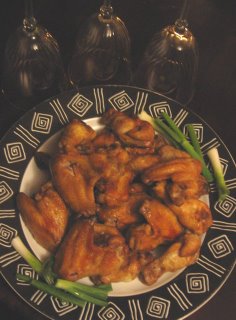 The chicken pieces not only provided us with something quite substantial but a different flavor note. I think the success behind good finger food is a range of textures and flavours. Eric liked putting Muhammara on the chicken fingers for a multi-dimensional flavour sensation :-)
Chicken Pieces in a Light Satay
(My angelheart Eric's own recipe)
2/3 cup soy sauce
1 1/2 tablespoons sesame oil
2 tablespoons satay paste
1 tablespoon honey
1 1/2 tablespoons peanut butter
juice of one lime
2 tablespoons dry vermouth
1 medium serrano chilis, chopped (ribs removed if you don't want the heat)
1 handful basil, roughly chopped
4 cloves garlic, roughly chopped
pinch of salt
1/4 cup water
2 pounds chicken pieces (about 24 drumettes)
1) Combine all but water in a food procssor.
2) Pour mixture out into a big bowl and stir in the water.
3) Add chicken to marinade and leave in refrigerator for four hours but preferably overnight.
4) Preheat oven to 300 deg. f. (about 150 deg. c.).
5) Bring chicken pieces to room temperature before laying them out on a baking sheet.
6) Cook in oven until chicken cooked through, about 40 minutes.
 Creme Brulee is one of the first desserts I ever tried to make because of its simple yet elegant composition. When I finally (i.e. slowly) realized that what was beneath the burnt sugar was basically a custard, I turned to making creme brulee myself. The "Party Food" version, keeping with the theme of small and easy to eat, includes 1/4 cup brandy (for 6 creme brulees, mind you). My angelheart Eric and the divine poetess Suzanne loved it; I thought it was a little heavy-handed. Too much alcohol, in my view, overpowers the elegance of this dessert. Next time I will use less booze (not something you will hear me say too often), and maybe amaretto instead.
Brandy Creme Brulee
(inspired by Debbie Puente's Elegantly Easy Creme Crulee, and she suggests cognac instead of brandy, but we didn't have any on hand)
7 egg yolks
1/3 cup granulated sugar
2 cups heavy cream
1/4 cup brandy or cognac
1 teaspoon vanilla extract
1 teaspoon sugar per ramekin, for the brulee
1) Preheat oven to 300 deg. f. (150 deg. c.).
2) In a large bowl, whisk together egg yolks and sugar until mixture is thick and pale yellow.
3) Combine cream and brandy, then add to egg mixture with vanilla and whisk until well blended.
4) Strain into a bowl, skimming off foam.
5) Divide mixture among six ramekins or custard cups.
6) Put ramekins on a rimmed baking sheet or roasting pan, and fill vessel up with hot water until it comes halfway up the ramekins (this is a bain marie and what it does it to moderate the temperature of the yolks so they do not harden...no one ones a scambled egg brulee for dessert).
7) Bake until set around the edges but still loose in the center - 40 to 50 mintues.
8) Take ramekins out of bain marie and chill for at least two hours or up to two days.
9) When ready to serve, sprinkle approximately one tablespoon of sugar over the surface of the custard and blast with a kitchen torch. If you do not have a kitchen torch, put under a broiler until the sugar has melted.
Everything was easy to make and is enough to feed six...
This is actually my second attempt to type this post because as I was doing it last night, in an effort to meet the deadline as we ate the "Party Food", my angelheart Eric knocked a stack of cookbooks off a chair ledge and they landed on the power strip! So, everything went down, and, of course, the server does not "emergency save" documents as does Windows. It was well after 10pm then, and I just decided I'd try again as soon as I got up this morning.
So, I've given away the theme to WCC #11 already: Party Food. Isn't every meal an invitation to party for us foodies? My angelheart Eric and I often host little dinner parties, wine tasting parties, and big events parties (mostly New Year's Eve), so I really wasn't sure how to tackle this month's theme. I just decided on something simple, for most of us are still full from feasting at Thanksgiving meals. The small party number went from five to three (including the hosts!). It was to be seen as a catch up over finger food, and it ended up being quite a lot to eat for 3, and we ate quite a bit of it over the course of a couple of hours. I made two types of dip, Bagna Cauda (from The Stinking Rose Restaurant Cookbook) and Muhamarra (from Claudia Roden's The New Book of Middle Eastern Food), Zucchini Frittata (it was meant to be zucchini fritters, but the batter kept sticking to the frying pan; the recipe is mostly modeled after one from Claudia Roden's fabulous Arabesque), and Brandy Creme Brulee (there is almost no need to cite a reference as I could have done this with my eyes closed, but the inspiration to add brandy came from Debbie Puente's Elegantly Easy Creme Brulee that my darling friend Lily gave to me almost two years ago). My angelheart Eric made Chicken Pieces Marinated in a Light Satay - his own recipe.
 When I first moved to the U.S., my angelheart and I often had dinners with friends in Beverly Hills at The Stinking Rose, a garlic-themed restaurant. It is a high energy restaurant (on account of its lively staff and individually-themed rooms) with great food that is made consistently well (usually if I like something a lot the first time, I order it time and again). I always made sure there was bagna cauda (hot bath) on the table. I could have used Tamasin Day-Lewis' recipe from Tamasin's Weekend Food, but I wanted to recapture something from my early days in the U.S., and it has been a really long time since my angelheart and I were last at The Stinking Rose.
Bagna Cauda
(from Andrea Froncilla and Jennifer Jeffrey's The Stinking Rose Restaurant Cookbook)
2 1/2 cups garlic cloves, skins intact (about 3 heads of garlic)
2 cups olive oil
1/4 cup unsalted butter (56.5g), cut into bits
6 anchovy fillets in olive oil (the recipe calls for a whole 2oz can)
1) Preheat oven to 275 deg. f. (135 deg. c.).
2) Put garlic cloves into a baking dish (either cermaic or heavy glass is suggested, but it worked well in our pink(!) stoneware LeCreuset baking dish).
3) Pour olive oil over garlic.
4) Sprinkle butter over garlic.
5) Lay anchovy fillets in a single layer on top.
6) Cover with aluminium foil and bake until clovers are easily squishable (preferably dense and limp - approximately 1 1/2 hours).
7) To serve: Use a spoon to slot out one clove and use the back of the spoon to press out the garlic onto a slice of baguette or focaccia.
 Muhammara is a walnut and pomegranate relish that is made in Turkey and Syria. Each component adds incredible depth to an all-too-simple accompaniment: the walnuts provide the nubbly texture, the pomegranate syrup gives the tart-yet-sweet high notes, while the cumin adds the smokey low-note. Served with cripsy pita bread, which we toasted in the oven after cutting into chips and sprinkling over a combination of kosher salt and flaky smoked Manuka honey sea salt.
Muhammara
(From Claudia Roden's The New Book of Middle Eastern Food)
1 1/4 cups shelled walnuts (or walnut pieces, if you can get them)
1 1/2 tablespoons tomato paste
1 slice whole-wheat bread, crusts removed, lightly toasted
1/2 cup extra-virgin olive oil
2 tablespoons pomegranate syrup
1 teaspoon coarsley ground red-pepper flakes
1 teaspoon ground cumin (I love that hit of smokiness that wafts up when milling cumin seeds with the pestle)
2 teaspoons sugar
salt, to taste
1) Blend all ingredients to a rough paste in a food processor.
That could not get any easier, and it is worth trying because it is an unusually sweet "dip" that had my angelheart Eric and the divine poetess Suzanne guessing the ingredients.
 The Turkish Zucchini Fritters (kabak mucveri) a la Claudia Roden did not work out because I didn't know what a finely chopped zucchini should look like (not the same as an onion, surely) and because we do not have a non-stick pan. So, we made a frittata-like dish out of it, and it worked out fine. It was an innocuous creamy background filler for the rest of the goodies.
Zucchini Frittata
(Inspired by Claudia Roden's Kabak Mucveri from Arabesque)
1 large onion, coarsley chopped
3 tablespoons vegetable oil (or sunflower oil)
1 pound zucchini, finely chopped (2 medium sized zucchini)
3 eggs
3 tablespoons all-purpose flour
black pepper, to taste
3 sprigs mint, chopped
2 sprigs dill (or 3, if you prefer, but I don't), chopped
7oz feta cheese, mashed with a fork (I used a Bulgarian feta because I had Silvena Rowe's Feasts on my mind when shopping...)
1) Fry onion in the oil over medium heat until soft and lightly colored.
2) Add zucchini and saute until soft.
3) Preheat oven to 325 deg. f. (about 165 deg. c.).
4) In a bowl, beat eggs with flour until well blended.
5) Add pepper and chopped herbs to egg mixture and mix well.
6) Fold mashed feta into egg and herb mixture with the onions and zucchini.
7) This is where I divurge from Claudia's path: Film bottom of frying pan with oil, pour in mixture and cook for 7 minutes.
8) Cook in oven until cooked on top and golden brown at the sides.
 The chicken pieces not only provided us with something quite substantial but a different flavor note. I think the success behind good finger food is a range of textures and flavours. Eric liked putting Muhammara on the chicken fingers for a multi-dimensional flavour sensation :-)
Chicken Pieces in a Light Satay
(My angelheart Eric's own recipe)
2/3 cup soy sauce
1 1/2 tablespoons sesame oil
2 tablespoons satay paste
1 tablespoon honey
1 1/2 tablespoons peanut butter
juice of one lime
2 tablespoons dry vermouth
1 medium serrano chilis, chopped (ribs removed if you don't want the heat)
1 handful basil, roughly chopped
4 cloves garlic, roughly chopped
pinch of salt
1/4 cup water
2 pounds chicken pieces (about 24 drumettes)
1) Combine all but water in a food procssor.
2) Pour mixture out into a big bowl and stir in the water.
3) Add chicken to marinade and leave in refrigerator for four hours but preferably overnight.
4) Preheat oven to 300 deg. f. (about 150 deg. c.).
5) Bring chicken pieces to room temperature before laying them out on a baking sheet.
6) Cook in oven until chicken cooked through, about 40 minutes.
 Creme Brulee is one of the first desserts I ever tried to make because of its simple yet elegant composition. When I finally (i.e. slowly) realized that what was beneath the burnt sugar was basically a custard, I turned to making creme brulee myself. The "Party Food" version, keeping with the theme of small and easy to eat, includes 1/4 cup brandy (for 6 creme brulees, mind you). My angelheart Eric and the divine poetess Suzanne loved it; I thought it was a little heavy-handed. Too much alcohol, in my view, overpowers the elegance of this dessert. Next time I will use less booze (not something you will hear me say too often), and maybe amaretto instead.
Brandy Creme Brulee
(inspired by Debbie Puente's Elegantly Easy Creme Crulee, and she suggests cognac instead of brandy, but we didn't have any on hand)
7 egg yolks
1/3 cup granulated sugar
2 cups heavy cream
1/4 cup brandy or cognac
1 teaspoon vanilla extract
1 teaspoon sugar per ramekin, for the brulee
1) Preheat oven to 300 deg. f. (150 deg. c.).
2) In a large bowl, whisk together egg yolks and sugar until mixture is thick and pale yellow.
3) Combine cream and brandy, then add to egg mixture with vanilla and whisk until well blended.
4) Strain into a bowl, skimming off foam.
5) Divide mixture among six ramekins or custard cups.
6) Put ramekins on a rimmed baking sheet or roasting pan, and fill vessel up with hot water until it comes halfway up the ramekins (this is a bain marie and what it does it to moderate the temperature of the yolks so they do not harden...no one ones a scambled egg brulee for dessert).
7) Bake until set around the edges but still loose in the center - 40 to 50 mintues.
8) Take ramekins out of bain marie and chill for at least two hours or up to two days.
9) When ready to serve, sprinkle approximately one tablespoon of sugar over the surface of the custard and blast with a kitchen torch. If you do not have a kitchen torch, put under a broiler until the sugar has melted.
Everything was easy to make and is enough to feed six...
Labels: Claudia Roden, Weekend Cookbook Challenge
Monday, September 04, 2006
Weekend Cookbook Challenge # 8
I decided to participate in the eighth Weekend Cookbook Challenge (WCC), putting a cookery book of choice to practical use. Truthfully, I use my cookbooks whenever I cook, but I haven't quite gotten around to using all of them yet, and being required to use them makes the compulsive cookery book shopper in all of us feel less guilty; the idea behind WCC is thus beneficial as one feels simultaneously accomplished and spiritually cleansed. The theme for this WCC is a foreign dish, one that is foreign to the cook, that is.
I'm sure that half of the dilemma in submitting to WCC is deciding which cookery book to use. Fortunately, I knew from the outset that I wanted to make a small meal (main dish, side vegetable plate, and dessert) from Claudia Roden's magnificent The New Book of Middle Eastern Food. Because the Middle East is a vast area and is constituted of many cultures, it was very difficult to decide what to make. I resolved myself to making dishes from Ms. Roden's country of birth, Egypt. I served Hamam Mahshi bil Burghul (poussin/squab/pigeon stuffed with bulgur wheat, raisins and pine nuts), Bamia bel Takleya (okra with garlic and ground coriander/cilantro), and Assabih bi Loz (almond fingers).
How did it all taste?
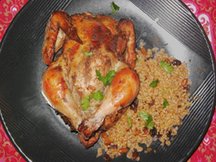 I could not find poussins when shopping, so, sticking to the small bird notion, I bought cornish hens instead. The coarse bulgur wheat that was cooked inside the hens absorbed the hens' juices and made for a most flavorful and comforting accompaniment to the tender and juicy hens.
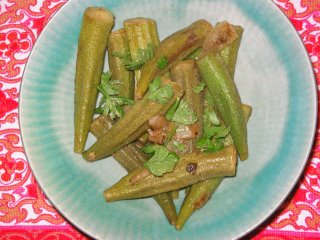 I wanted to make the okra dish because I had never used okra before - I'm not even sure if it is available in New Zealand because I had never heard of it before moving to the U.S. Knowing in advance that badly cooked okra resulted in a slimey mess, I was prepared to not enjoy the result, but it didn't turn out slimey at all (perhaps due to cutting off the stems and caps). The seeds contained in the okra gave the skin infused with garlic and coriander an little kick without overpowering heat.
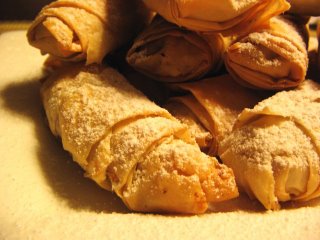 My angelheart Eric is not a fan of orange-blossom water, but I wanted to make the almond fingers anyway since I had not worked with filo before. My goodness, how fiddly it is! One has to ensure that the sheets not in use are covered with a damp cloth so they do not dry out; they are susceptible to dry air. Fortunately, I was well-armed with this information due to Roden's clear and concise guidance. Eric thought that the almond fingers tasted like soap; I, on the other hand, like orange-blossom water and thought that the combination of the crisp filo and the almond paste made for a delicately flavoured and other-world-transporting dessert. I miscalculated the amount of almond I needed, so I added walnuts that I had on hand, but this is not a real deviation as Ms. Roden suggests using walnuts to create a Turkish variation.
The following recipes take into account my ingredient subsitutions and portion sizes (for two people).
Hamam Mahshi bil Burghul (Pigeon, Squab or Poussin stuffed with Bulgur, Raisins, and Pine Nuts)
2 cornish hens (approximately 1.25 pounds each)
For the marinade:
1/3 large onion, finely chopped
Juice of 1/3 lemon
2 tablespoons vegetable oil (or butter)
salt
pepper
1/2 teaspoon ground cardamom
1/2 teaspoon ground cinnamon
1/4 teaspoon allspice
For the stuffing:
1 1/2 cups chicken stock
1/3 pounds coarse bulgur wheat
salt
pepper
1/2 teaspoon ground cinnamon
1/4 cup pine nuts
1 1/4 tablespoons vegetable oil (or butter)
1/4 cup raisins, soaked in water for 15 minutes
1) For the marinade, combine all ingredients in a blender until liquidised.
2) Marinate the birds for 30 minutes (for deeper flavour, however, the birds could stand up to being marinated for longer, which is what I will do next time).
3) For the stuffing, bring chicken stock to a boil in a pan, then add the bulgur wheat, salt, pepper, and cinnamon. Stir together, cover, and simmer for 15 minutes, or until the liquid is absorbed and the bulgur is tender.
4) Preheat oven to 350 deg. f. (180 deg. c.)
5) Fry the pine nuts in 1/3 tablepoon of vegetable oil until lightly browned.
6) Add the pine nuts, raisins, and remaining vegetable oil to the bulgur wheat and mix well.
7) Stuff the hens 2/3 with the bulgur mix, allowing room for bulgur to expand, and then secure the legs with kitchen twine (toothpicks can be used on smaller birds).
8) Rub some of the marinade on the hens, then put them in the oven spine side up for 25 minutes.
9) Turn birds over (breast side up) for 20 minutes, while at the same time roasting the remaining bulgur wheat mix covered with foil for 15-20 minutes. The birds are cooked through when the juices from the thick part of the thigh run clear.
Bamia bel Takleya (Okra with Garlic and Coriander)
1/3 pound small, young okra with stems and caps sliced off
1/3 onion, chopped
1 tablespoon vegetable oil
salt
pepper
2 cloves garlic
1 teaspoon ground coriander
1 1/2 cups water
1) Fry the onion in the 2/3 of the vegetable oil until golden.
2) Add the okra and saute gently for 5 minutes.
3) Barely cover with water, add salt and pepper, and simmer for 20 minutes or until tender.
4) Heat the garlic and coriander in the remaining 1/2 of the vegetable oil, stirring for 1 minute or until garlic is lightly coloured.
5) Stir garlic and coriander into okra, and cook for a two minutes before serving hot.
Assabih bi Loz (Almond Fingers)
1/4 pounds filo pastry sheets (approximately 4 sheets)
3/4 cup ground almonds
1/4 cup ground walnuts
1/4 cup superfine sugar
1 1/2 tablespoons orange-blossom water
3 tablespoons butter, melted
confectioners' sugar (for decoration only)
1) Mix ground almonds and walnuts with the suger and orange-blossom water.
2) Cut the filo sheets into 4 rectangular strips about 12 by 4 inches (30.5 by 10 cms) and pile them on top of each other, covering the top one with a damp cloth.
3) Preheat oven to 325 deg. f. (170 deg. c.)
3) Take the top sheet of filo, cover lightly with melted butter, and roll a heaped teaspoon of the almond filling into a sausage shape before placing it 1 inch (2 cms) from the edge of one of the short ends of the filo sheets.
4) Roll edge of filo sheet over almond filling.
5) Roll into a cigar shape, folding the longer sides slightly over the almond filling midway.
6) Place on a baking sheet lined with parchment paper (or butter the baking sheet).
7) Repeat with all filo sheets. Makes approximately 16.
8) Bake in oven for approximately 30 minutes, or until lightly golden.
9) Serve cold sprinkled with confectioners' sugar.
I'm sure that half of the dilemma in submitting to WCC is deciding which cookery book to use. Fortunately, I knew from the outset that I wanted to make a small meal (main dish, side vegetable plate, and dessert) from Claudia Roden's magnificent The New Book of Middle Eastern Food. Because the Middle East is a vast area and is constituted of many cultures, it was very difficult to decide what to make. I resolved myself to making dishes from Ms. Roden's country of birth, Egypt. I served Hamam Mahshi bil Burghul (poussin/squab/pigeon stuffed with bulgur wheat, raisins and pine nuts), Bamia bel Takleya (okra with garlic and ground coriander/cilantro), and Assabih bi Loz (almond fingers).
How did it all taste?
 I could not find poussins when shopping, so, sticking to the small bird notion, I bought cornish hens instead. The coarse bulgur wheat that was cooked inside the hens absorbed the hens' juices and made for a most flavorful and comforting accompaniment to the tender and juicy hens.
 I wanted to make the okra dish because I had never used okra before - I'm not even sure if it is available in New Zealand because I had never heard of it before moving to the U.S. Knowing in advance that badly cooked okra resulted in a slimey mess, I was prepared to not enjoy the result, but it didn't turn out slimey at all (perhaps due to cutting off the stems and caps). The seeds contained in the okra gave the skin infused with garlic and coriander an little kick without overpowering heat.
 My angelheart Eric is not a fan of orange-blossom water, but I wanted to make the almond fingers anyway since I had not worked with filo before. My goodness, how fiddly it is! One has to ensure that the sheets not in use are covered with a damp cloth so they do not dry out; they are susceptible to dry air. Fortunately, I was well-armed with this information due to Roden's clear and concise guidance. Eric thought that the almond fingers tasted like soap; I, on the other hand, like orange-blossom water and thought that the combination of the crisp filo and the almond paste made for a delicately flavoured and other-world-transporting dessert. I miscalculated the amount of almond I needed, so I added walnuts that I had on hand, but this is not a real deviation as Ms. Roden suggests using walnuts to create a Turkish variation.
The following recipes take into account my ingredient subsitutions and portion sizes (for two people).
Hamam Mahshi bil Burghul (Pigeon, Squab or Poussin stuffed with Bulgur, Raisins, and Pine Nuts)
2 cornish hens (approximately 1.25 pounds each)
For the marinade:
1/3 large onion, finely chopped
Juice of 1/3 lemon
2 tablespoons vegetable oil (or butter)
salt
pepper
1/2 teaspoon ground cardamom
1/2 teaspoon ground cinnamon
1/4 teaspoon allspice
For the stuffing:
1 1/2 cups chicken stock
1/3 pounds coarse bulgur wheat
salt
pepper
1/2 teaspoon ground cinnamon
1/4 cup pine nuts
1 1/4 tablespoons vegetable oil (or butter)
1/4 cup raisins, soaked in water for 15 minutes
1) For the marinade, combine all ingredients in a blender until liquidised.
2) Marinate the birds for 30 minutes (for deeper flavour, however, the birds could stand up to being marinated for longer, which is what I will do next time).
3) For the stuffing, bring chicken stock to a boil in a pan, then add the bulgur wheat, salt, pepper, and cinnamon. Stir together, cover, and simmer for 15 minutes, or until the liquid is absorbed and the bulgur is tender.
4) Preheat oven to 350 deg. f. (180 deg. c.)
5) Fry the pine nuts in 1/3 tablepoon of vegetable oil until lightly browned.
6) Add the pine nuts, raisins, and remaining vegetable oil to the bulgur wheat and mix well.
7) Stuff the hens 2/3 with the bulgur mix, allowing room for bulgur to expand, and then secure the legs with kitchen twine (toothpicks can be used on smaller birds).
8) Rub some of the marinade on the hens, then put them in the oven spine side up for 25 minutes.
9) Turn birds over (breast side up) for 20 minutes, while at the same time roasting the remaining bulgur wheat mix covered with foil for 15-20 minutes. The birds are cooked through when the juices from the thick part of the thigh run clear.
Bamia bel Takleya (Okra with Garlic and Coriander)
1/3 pound small, young okra with stems and caps sliced off
1/3 onion, chopped
1 tablespoon vegetable oil
salt
pepper
2 cloves garlic
1 teaspoon ground coriander
1 1/2 cups water
1) Fry the onion in the 2/3 of the vegetable oil until golden.
2) Add the okra and saute gently for 5 minutes.
3) Barely cover with water, add salt and pepper, and simmer for 20 minutes or until tender.
4) Heat the garlic and coriander in the remaining 1/2 of the vegetable oil, stirring for 1 minute or until garlic is lightly coloured.
5) Stir garlic and coriander into okra, and cook for a two minutes before serving hot.
Assabih bi Loz (Almond Fingers)
1/4 pounds filo pastry sheets (approximately 4 sheets)
3/4 cup ground almonds
1/4 cup ground walnuts
1/4 cup superfine sugar
1 1/2 tablespoons orange-blossom water
3 tablespoons butter, melted
confectioners' sugar (for decoration only)
1) Mix ground almonds and walnuts with the suger and orange-blossom water.
2) Cut the filo sheets into 4 rectangular strips about 12 by 4 inches (30.5 by 10 cms) and pile them on top of each other, covering the top one with a damp cloth.
3) Preheat oven to 325 deg. f. (170 deg. c.)
3) Take the top sheet of filo, cover lightly with melted butter, and roll a heaped teaspoon of the almond filling into a sausage shape before placing it 1 inch (2 cms) from the edge of one of the short ends of the filo sheets.
4) Roll edge of filo sheet over almond filling.
5) Roll into a cigar shape, folding the longer sides slightly over the almond filling midway.
6) Place on a baking sheet lined with parchment paper (or butter the baking sheet).
7) Repeat with all filo sheets. Makes approximately 16.
8) Bake in oven for approximately 30 minutes, or until lightly golden.
9) Serve cold sprinkled with confectioners' sugar.
Labels: Claudia Roden, Weekend Cookbook Challenge