Sunday, September 21, 2008
Duck Confit
 In the week leading up to a recent visit to Los Angeles, my angelheart Eric and I were aware that we would be dining out most days and nights - not to be extravagant, but to give some teeth to the various discussions we have had together and with friends on the direction of Californian cooking and American cuisine in general (amongst the chosen restaurants were AOC, Fraiche and Craft LA). This meant that we had to make a real celebration of our home cooking because we would not be blessed with many occasions, and also because we did not know when we would next be able to share space in a kitchen. My angelheart Eric suggested that we prepare something that we've always been curious about and that wouldn't do our heads in - time being too precious to waste any of it on frustration and stress (and let us not forget that I was on holiday, too!).
 Recently it seems that the food presented on this blog leans in the direction of French cuisine, but I assure that you that this is not how I really approach decision-making in the kitchen. Sure, I am often swayed by cultural influences, curious combinations and new techniques; however, it is not my goal to continue to exhalt French cuisine, whatever that is.
 That said, confit is a celebrated south-western French method for preserving meat. This is not a terribly difficult process, but it is one that takes place over many hours. Each step requires slight attention in order to produce a confit that is not salty or fatty (irrespective of the fat that it is salted for many hours and then immersed in fat as it cooks and sits, if one is not eating it immediately).
 The following recipe requires for four duck legs, but you can also try boneless duck breasts, rabbit, chicken or the shoulder of pork, as Judy Rodgers recommends in The Zuni Cafe Cookbook. Instead of leaving the meat dusted in salt for 18-24 hours, my angelheart Eric and I left it only for 12 hours because we out the duck legs through a marinating process that is not typical of most confit preparations. This is one of the many reasons my angelheart Eric and I adore Kate Fay and Jeremy Turner of Cibo and R'ce fame.
Duck Confit
(Adapted from Kate Fay and Jeremy Turner's Cibo: Food with Attitude)
4 duck legs
5 tablespoons sea salt
duck fat (rendered to cover the duck legs during cooking, approximately 620ml/21oz)
1/2 yellow onion, peeled and chopped
6 cloves of garlic
1 orange
1 tablespoon juniper berries, crushed
2 tablespoons dried marjoram
4 dried bay leaves
1 tablespoon black cracked pepper
2 teaspoons five spice powder
1 tablespoon Szechuan peppercorns, crushed
1) Coat the legs with sea salt (1 1/4 tablespoons per leg) and leave overnight, 12 hours' minimum, 18-24 hours for optimal result. Regarding the salt, in the magnificent The Zuni Cafe Cookbook, Judy Rodgers' experience has led her to recommend 2 tablespoons per pound of meat. It is the salt curing that preserves the duck legs.
2) Remove the salt by washing it off under a stream of cold water.
3) Pat the legs dry with paper towels.
 4) Mix onion, juniper berries, marjoram, bay leaves, black cracked pepper, five spice powder and Szechuan peppercorns together to make a spice mixture.
 5) Coat the duck legs in spice mixture, cover and refrigerate for 12 hours.
6) Preheat oven to 120 C/250F.
7) Place the legs in a roasting pan with the marinade.
8) Squeeze the juice of one orange and sprinkle sliced orange peel over the legs.
9)Cover with melted duck fat. It is important that the duck meat is fully immersed in the fat.
10) Cover the pan with tinfoil and cook the duck legs for 2 1/2 hours, or until the meat is coming away from the bone.
11) Allow the duck legs and fat to cool before refrigerating overnight or until it is time to eat them. Again, ensure that the duck fat conceals the duck legs if you are going to leave in the refrigerator for more than 1-2 days (and especially if you are going to leave for months).
12) To reheat, bring meat out at least one hour prior to cooking so that meat can be loosened from solidified fat, if one is not going to cook all the meat. Preheat oven to 180 C/355 F, then cook for 20 minutes. Lightly pat duck legs with paper towel and brush off residual marinade and orange peel prior to serving.
 Generally, confit of duck is browned before serving, but neither we nor our friends were particularly fussed (you will note that we also didn't bother with trimming the edges of fat around the long end of the bone before preparing, but you can do this and render the fat for this dish). The marinade produces a beautiful colouring on the duck skin, like sunset. The flesh is perfectly done, which is to say meltingly tender. Whilst we had prepared duck confit as part of an informal pot-luck, it is more popularly served with pommes salardaises, potatoes sauteed with garlic in goose fat.
 This appears to be a year of crossing culinary firsts off the list, thanks to my angelheart Eric. I'd love to know what culinary firsts you have or plan to attempt this year.
P.S. Thank you to Jasmine of Confessions of a Cardamom Addict for the Yum-yum Blog Award. It is a delight to receive such recognition from a fellow blogger whose work I admire and whose friendship I enjoy. In the generous nature of this award, I would like to share the world of Christina at A Thinking Stomach. Christina's insightful prose on garden-keeping elevates it to an art form, as opposed to keeping a garden for sheer subsistence.
Labels: confit, duck, French, Kate Fay and Jeremy Turner, technique


Saturday, October 07, 2006
Posh Guy Food
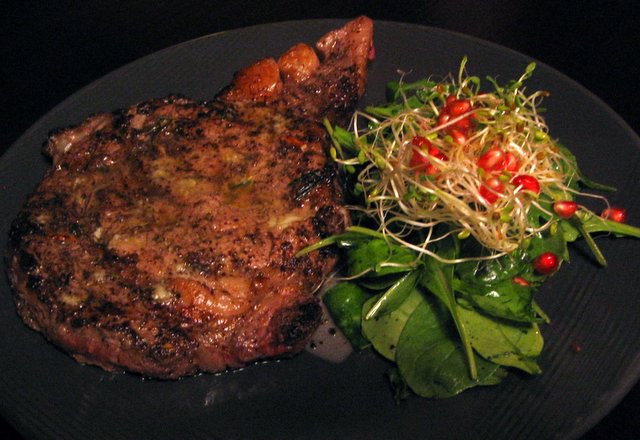 Sometimes my angelheart Eric and I just want a nice slab of steak. Well, Eric would be happy with a slab of meat every other day providing he also has seafood on the alternate days - since I do not take well to all forms of seafood and because I object to consuming too much red meat, Eric gets his slab of meat once a week (keep your minds clean, people!). Okay, perhaps not a slab of meat, but a nice New York cut suits us just fine.
 This time, we took our cue for the marinade and salad dressing from Kate Fay and Jeremy Turner's Cibo: Food with Attitude, in which the recipes are taken from their repertoire of predominantly fusion dishes (New Zealand fare interlacing sauces and rubs from Asia and the Middle East) served at Cibo in Auckland, New Zealand.
We marinated the steak overnight in Fay and Turner's Sumac Crust, to which we added soy sauce and honey. Because sumac is distinctively smoky and citrusy (augmented by the herbs used), we wanted to round it out so as not to compete with the dressing for our salad. Do not get me wrong, the sumac crust is outstanding, and it is only because we were concerned with pairing flavours that we turned it into a marinade.
Speaking of the dressing, we had neither sunflower oil nor mirin, so we focused on highlighting the simultanous sweetness and tartness of the pomegranate molasses. We also substituted the call for white wine vinegar with dry vermouth, mostly because we find it slightly less acidic and, consequently, less overpowering. This dressing works superbly as a counterbalance to the arugula's pepperiness, which is mellowed out by the nuttiness of bean sprouts. A more-than-fabulous combination.
Before getting on to the ingredients and methods of preparation, I have to meantion the ease of pressing out the juice of a pomegranate and of picking out the seeds. I have often heard that it is difficult to do both, but I find it to be reasonably easy. To exact the pomegranate's juice, lightly squeeze all around the pomegrante before simply inserting the blade of a paring knife 1"/2.5cm into the pomegranate. Hold the pomegranate such that the incision mark is held over a bowl, and then squeeze the fruit. The juice should be fairly free-flowing with tight squeezes. To extract the seeds, insert the blade of a paring knife into the top of the pomegranate and abruptly crank it. The pomegranate should gently open, and you can then tear across its naturally occurring segements (designated by the pith). Once deconstructed, you can then pick out or gently flick the seeds into the vessel of your choice.
The following quantites are enough for two, or at least for us :-p
New York Steak with Sumac Marinade
(Adapted from Kate Fay and Jeremy Turner's Cibo: Food with Attitude)
4 tablespoons sumac
1 tablespoon cracked black pepper
1 tablespoon garlic puree
1 tablespoon dried oregano
1 tablespoon fresh rosemary, finely chopped
1 tablespoon honey (we use Pohutakawa honey from New Zealand)
1 tablespoon soy sauce
2 tablespoons olive oil
1) Combine above ingredients together, using the olive oil last as a binding agent.
2) Coat New York steaks and marinade for at least 4 hours.
3) Pat steaks dry before pan-frying in a heavy-bottomed skillet to your satisfaction (we prefer our beef rare).
Arugula and Bean Sprout Salad with Pomegranate and Honey Dressing
(Adapted from Kate Fay and Jeremy Turner's Cibo: Food with Attitude)
5 tablespoons olive oil
2 tablespoons vermouth or white wine vinegar
2 tablespoons honey
2 teaspoons soy sauce
1 tablespoon fresh rosemary, finely chopped
1 teaspoon sumac
2 teaspoons pomegranate molasses
sea salt and freshly ground black pepper to taste
seeds of 1/2 fresh pomegranate
arugula, enough for two
bean sprouts, enough for two
1) Combine above ingredients bar the pomegranate seeds, arugula, and bean sprouts.
2) When combined well, toss in the arugula and gently fold in most of the pomegranate seeds, leaving some to sprinkle once the salad has been constructed.
3) To construct salad: Make a bed of arugula, then add bean sprouts, and top this off with the reserved pomegranate seeds.

Labels: Kate Fay and Jeremy Turner, Steak, Sumac