Sunday, November 09, 2008
That Cookbook Thing II - Tournedos Sautés Chasseur
 I don't know about you, but I cannot keep all the various cuts of meat straight. It has been most confusing keeping track of what one calls a particular cut in New Zealand and what one calls the same thing in the US. It is even more confusing when translating the same cut from another language - I need to check a few references (first, the one in the language/country from which I have found the recipe source) before finding a synonymous cut in New Zealand. It really does my head in. Perhaps this is because I'm easy when it comes to meat - no pun intended. If I see oxtail, I think of braising; if I see sirloin, I think of frying (in all its sanguineous glory, please). I have neither an allegiance to a selection of meat nor to a method of cooking. Today's choice selection, tournedos, ensured that I checked a few references before embarking on a the recipe selected for That Cookbook Thing II.
And so the research question: What is tournedos? Because today's post reflects a selection of meat recipes from Julia Child, Louisette Bertholle, and Simone Beck's first volume of Mastering the Art of French Cooking, it is best to see how Child et al. describe it. Better than verbal description alone, the ladies provide a cross-section diagram of a whole filet of beef. Tournedos is located in the T-bone steak section, which is towards the lower back, as opposed to the shoulder/rump. The T-bone is divided into two sections: tournedos (next to the filet steak of the porterhouse cut) and filet mignon (at the extremity of the rib end of the steak). This is clear enough, but another source, Martha Stewart, says that filet mignon and tournedos are the same thing in America. This conflicts with Julia Child's lesson, which is directed to an American audience. New Zealand Beef tells you that one side of the T-bone flesh is the tenderloin, agreeing with Child et al., one part of this is the tournedos. My head hurts already, but I think we're there...
The commonality of all these descriptions is the rib end of the beef steak (but not its extremity, which is the filet mignon), no matter whom you listen to. Armed with this basic understanding of steak, I trotted off to my butcher par excellence, the wonderful guys at Seaview Meats, and ordered: "Tournedos, or whatever one is calling it today. I would like six healthy portions of it, and all I know is that it is not the filet mignon but the the other bit of the T-bone's tenderloin." Exhibit A, this post's opening photograph, is what I got.
As you can see, it is not as marbeled as the filet steak (cut from the mid-section - aka Porterhouse), but it is indeed tender. The lack of marbling is an excuse to fry the steak with strips of pork fat.
The following recipe serves 6.
Tournedos Sautés Chasseur
(from Julia Child, Louisette Bertholle, and Simone Beck's first volume of Mastering the Art of French Cooking)
6 rounds of bread, thinly sliced, crust removed (I used one of spelt and flax seed)
4 tablespoons clarified butter
250g/ 1/2lb fresh mushrooms, whole or quartered if big
4 tablespoons unsalted butter, divided use
2 tablespoons oil, divided use
2 tablespoons minced shallots
salt
pepper
6 tournedos, each bundled in a strip of gorgeous fat
1/2 cup beef stock
1 tablespoon tomato paste
1/4 cup brandy (or Madeira), mixed with 1 tablespoon cornstarch (or arrowroot)
1 1/2 tablespoons parsley, minced
1) Sauté the rounds of bread in the clarified butter, lightly browned on each side. Re-heat at 180 C/350 F immediately before serving.
2) Sauté mushrooms in 2 tablespoons butter and 1 tablespoon oil.
3) Stir in shallots and cook over medium-low heat for two minutes. Season with salt and pepper, then set aside.
4) Heat up 2 tablespoons butter and 1 tablespoon olive oil in sauté pan over medium-high heat. When butter foams, sauté the tournedos to your preference, then immediately remove from heat. Season the tournedos and plate each one on a separate piece of browned bread. Keep warm while the following sauce is prepared.
5) Remove fat from the sauté pan in which your prepared the steaks, add stock and tomato paste. Boil fiercely, scraping up the browned bits (the fond) and cooking juices.
6) When the liquid is reduced to but 2-3 tablespoons, add brandy and starch mixture. Boil until alcohol has evaporated and sauce has thickened.
7) Add sautéed mushrooms, simmer to blend the flavours and taste for seasoning.
8) Spread mushrooms over the steaks.
9) Sprinkle parsley over the dish.
 Ms. Child recommends that the dish is served with whole-roasted tomatoes, artichoke hearts prepared in butter, or potato balls sautéed in butter. I roasted tomatoes with olive oil, salt, pepper and thyme. I also served the dish with sautéed bok choy, which is not French at all, but I like to serve red meat with greens. You, of course, will do as you please.
Even though the dish serves 6, I had two tournedos. I was feeling very greedy but regretted it soon after. One really is enough if one wants dessert afterwards (besides, one supposedly shouldn't consume more meat than the size of one's palm). In terms of repeatability, the tournedos, truthfully, are very simply prepared. I will marinate them next time. The mushrooms work well in the sauce, but it is too tomato heavy, really. Less tomato paste and perhaps some herbs will liven it up next time. As seems to be the case with all the recipes attempted for That Cookbook Thing II, Mastering the Art of French Cooking provides the willing cook with wonderful foundational material from which one can spring forth with personal additions and twists.
Please visit the posts of my friends in the blogging community who have also tried this dish as part of That Cookbook Thing II: Mike at Mel's Diner, Sara at I Like to Cook, Ruth at Once Upon A Feast, and Deborah at What's In My Kitchen?.
Labels: Book Review, French, Julia Child, Steak, That Cookbook Thing II, Tournedos


Saturday, August 11, 2007
Ribeye Steak Marinated with Juniper Berries, Star Anise and Rosemary
 Not so long ago, during a wet Winter's afternoon in Auckland, I braised a leg of lamb (see here). Amongst the list of ingredients were juniper berries. I couldn't find any at the time, but I resolved to use them during the Californian Summer, for my angelheart Eric and I had bought some in Colorado in February (well, from an import store that brought them in from Hungary). Though I knew I wouldn't be as interested in braising meat in a hot August kitchen, the thought of making a marinade for ribeye (entrecôte) steak was implanted. Ribeye is a cut of meat that always pleases my angelheart Eric, and out of all steak cuts, this is my preferred for grilling as it has the perfect mix of fat and lean.
If I were not a fan Bombay Sapphire - my chosen spirit when out, if not having wine or cocktails - I don't think I would have been able to describe the properties of juniper berries; however, "gin" is not an adjective, is it? Further inhalations of the deeply hued cones (for that is what they are - not actual berries) conjure up images of an Alpine slope: piney (or resinous, as the younger berries tend to be) with a hint of citrus. Think of clear blue skies with a sharp, biting wind. On its own, though, it is perhaps too sharp. In Central and Northern Europe, juniper berries are often a component of sauerkraut, in a love triangle with caraway seeds and bay leaves. For our marinade, my angelheart Eric and I incorporated star anise, which was chosen to temper the juniper berries with a complex sweetness but offering the same clarity in taste as juniper berries, and rosemary, matching the juniper berries' woodiness with depth.

The oil of juniper berries is best released when lightly crushed using a mortar and pestle. This is the opposite for star anise, which in my experience releases its aroma when only lightly toasted. This is a common ingredient in many Taiwanese stews and soups. I am just a shameless hustler for all things that have the chemical compound anethole: fennel, ouzo, licorice, tarragon, chervil, Sambuca...The rosemary, which we plucked from the shrub in the yard, can be removed from its woody stem and be lightly bruised with the juniper berries.
Ribeye Steak Marinated with Juniper Berries, Star Anise and Rosemary
1 stem rosemary
1 1/2 tablespoons juniper berries
3 crowns star anise
1 1/2 tablespoons soy sauce
3/4 tablespoon runny honey
1/4 cup olive oil
black pepper, freshly crushed
salt
2 Ribeye steaks, approximately 1/2kg/1lb each
1) Remove the leaves of rosemary from the stem and cut thinly. Throw into a mortar.
2) Add the juniper berries to the rosemary in the mortar and crush lightly with a pestle.
3) Lightly toast the star anise, which is to say, take them off the heat when they are fragrant, which should only take a minute or two. Pound them.
4) Put the rosemary, juniper berries and star anise in a vessel large enough to comfortably snug in your cuts of meat. Add the soy sauce, honey and olive oil. Stir together to marry the ingredients.
5) Salt and pepper both sides of the steaks.
6) Put steaks into the vessel with the marinade, and rub the marinade into the steaks.
7) Leave to marinade in the fridge for at least one hour, turning the steaks over halfway through.
8) Bring steaks out of the fridge 20 minutes before you want to cook them.
9) Pat steaks dry with kitchen paper before pan-frying until desired done-ness. They are rare when springy to the touch, medium when slightly resistant, and well-done when they don't yield to the touch at all. Depending on your preference, this can take anywhere between 5 and 20 minutes.
 I do not pretend that this is a conventional combination of flavours. The elements are mostly my angelheart Eric's chosing, based on our many trials with coming up with interesting and penetrating marinades for well-marbled steaks. Though complex, the combination leaves one feeling quite light, and this can be attributed to the juniper berries and star anise. To avoid astringency, rosemary and soy sauce impart depth. As an equally light side, a bed of arugula dressed with a vinaigrette and shavings of smoked cheddar (for creaminess and mild depth) was most fitting.

Labels: Juniper Berries, Rosemary, Star Anise, Steak
Saturday, October 07, 2006
Posh Guy Food
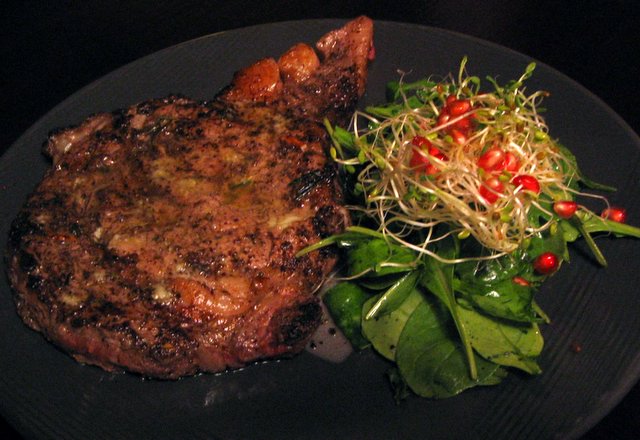 Sometimes my angelheart Eric and I just want a nice slab of steak. Well, Eric would be happy with a slab of meat every other day providing he also has seafood on the alternate days - since I do not take well to all forms of seafood and because I object to consuming too much red meat, Eric gets his slab of meat once a week (keep your minds clean, people!). Okay, perhaps not a slab of meat, but a nice New York cut suits us just fine.
This time, we took our cue for the marinade and salad dressing from Kate Fay and Jeremy Turner's Cibo: Food with Attitude, in which the recipes are taken from their repertoire of predominantly fusion dishes (New Zealand fare interlacing sauces and rubs from Asia and the Middle East) served at Cibo in Auckland, New Zealand.
We marinated the steak overnight in Fay and Turner's Sumac Crust, to which we added soy sauce and honey. Because sumac is distinctively smoky and citrusy (augmented by the herbs used), we wanted to round it out so as not to compete with the dressing for our salad. Do not get me wrong, the sumac crust is outstanding, and it is only because we were concerned with pairing flavours that we turned it into a marinade.
Speaking of the dressing, we had neither sunflower oil nor mirin, so we focused on highlighting the simultanous sweetness and tartness of the pomegranate molasses. We also substituted the call for white wine vinegar with dry vermouth, mostly because we find it slightly less acidic and, consequently, less overpowering. This dressing works superbly as a counterbalance to the arugula's pepperiness, which is mellowed out by the nuttiness of bean sprouts. A more-than-fabulous combination.
Before getting on to the ingredients and methods of preparation, I have to meantion the ease of pressing out the juice of a pomegranate and of picking out the seeds. I have often heard that it is difficult to do both, but I find it to be reasonably easy. To exact the pomegranate's juice, lightly squeeze all around the pomegrante before simply inserting the blade of a paring knife 1"/2.5cm into the pomegranate. Hold the pomegranate such that the incision mark is held over a bowl, and then squeeze the fruit. The juice should be fairly free-flowing with tight squeezes. To extract the seeds, insert the blade of a paring knife into the top of the pomegranate and abruptly crank it. The pomegranate should gently open, and you can then tear across its naturally occurring segements (designated by the pith). Once deconstructed, you can then pick out or gently flick the seeds into the vessel of your choice.
The following quantites are enough for two, or at least for us :-p
New York Steak with Sumac Marinade
(Adapted from Kate Fay and Jeremy Turner's Cibo: Food with Attitude)
4 tablespoons sumac
1 tablespoon cracked black pepper
1 tablespoon garlic puree
1 tablespoon dried oregano
1 tablespoon fresh rosemary, finely chopped
1 tablespoon honey (we use Pohutakawa honey from New Zealand)
1 tablespoon soy sauce
2 tablespoons olive oil
1) Combine above ingredients together, using the olive oil last as a binding agent.
2) Coat New York steaks and marinade for at least 4 hours.
3) Pat steaks dry before pan-frying in a heavy-bottomed skillet to your satisfaction (we prefer our beef rare).
Arugula and Bean Sprout Salad with Pomegranate and Honey Dressing
(Adapted from Kate Fay and Jeremy Turner's Cibo: Food with Attitude)
5 tablespoons olive oil
2 tablespoons vermouth or white wine vinegar
2 tablespoons honey
2 teaspoons soy sauce
1 tablespoon fresh rosemary, finely chopped
1 teaspoon sumac
2 teaspoons pomegranate molasses
sea salt and freshly ground black pepper to taste
seeds of 1/2 fresh pomegranate
arugula, enough for two
bean sprouts, enough for two
1) Combine above ingredients bar the pomegranate seeds, arugula, and bean sprouts.
2) When combined well, toss in the arugula and gently fold in most of the pomegranate seeds, leaving some to sprinkle once the salad has been constructed.
3) To construct salad: Make a bed of arugula, then add bean sprouts, and top this off with the reserved pomegranate seeds.
Labels: Kate Fay and Jeremy Turner, Steak, Sumac