Friday, December 29, 2006
Quince in Syrup (and ramblings on quince not being a "nana fruit")
 I had intended on making another quince tart before the season was over, as it is now, but it just seems like the best way to do is by following Tamasin Day-Lewis' recipe in Simply the Best. I say this because getting it the way I wanted, more similar to the Dapple-Dandy Pluot Tart I made in August this year, is really only best for true stone fruit. Quince just require more work and the less handling of them, the better. So, I go on record, for failing to reify my imagined "ultimate quince tart". Having said that, and let this be a lesson to anyone who does not cook or bake for fear of not pulling it off, exploration is a hands-on way of learning, a necessity really, in the kitchen. I feel that I have explored the quince's options, and I am now even better able to spot the best ones at the farmers' market. So "failure", really, is only subjective in this sense and not entirely negative. But I turn with tail between the legs to Tamasin Day-Lewis - again - for her version of Quince in Syrup. This particular recipe is from her educational, hunger-inducing, and wide-reaching tome, Tamasin's Kitchen Bible.
 My father all but cracked up laughing when I told him that I wanted to make this recipe. Why is it that people think quince is a nana's fruit? I suspect it has something to do with the Victorians leaving quince to scent linen cupboards, but this is originally, as far as I know, a Central Asian/Middle Eastern fruit, and the uses for it in jellies and as a sweet accent in savoury dishes are astounding (Central Asian and Middle Eastern dishes often act as harmonious offerings of the tart and sweet, the savoury and spicy - a dramatic study of balance). A nana fruit this is not. One does not or should not eat a quince directly off the tree, for it is incredibly hard and astringent. However, of the family of pears and apples it is, so like these fruit, it is best (in my opinion) cooked in any manner. It is once warmed through that the gorgeous tropical and floral aroma of the quince is released and casts spellbound gazes on all those whose olfactory organs are even minimally functioning.
Quince in Syrup
(from Tamasin Day-Lewis' Tamasin's Kitchen Bible)
juice of 1/2 lemon
8oz (225g) unrefined sugar
2lb (900g) quince (either 4 small or two really large ones) that have had the down scrubbed off them, halved (do not remove pips or stone) and sitting in acidulated water
1) Fill a pan with 1 3/4 pints (1 litre) boiling water and add lemon juice and sugar.
2) Add quince cut side down and simmer until tender (add more water as you go to keep them covered), anywhere between 20 and 60 minutes. Do not, however, let the fruit fall apart.
3) When tender, remove quince, and once cool enough to handle, cut out the cores and put them back in the pan.
4) Reduce the syrup by simmering.
5) Return quince to simmering liquid and cool until syrup becomes thick and reddish, approximately 75 minutes.
6) Arrange quice halves cut side up on a serving plate and pour syrup on top (it will turn into a jelly as it cools).
I do not dispute that this dessert takes a while before you can eat it, but it is worth it. Besides, you get to inhale that gorgeous aroma the entire time, and that cannot be bettered. Alas, the quince season seems to have ended here, so this will be my last quince entry for a while.

Labels: Quince, Tamasin Day-Lewis


Friday, November 24, 2006
Quince Tart (Deux)
 After my last attempt at making a quince tart, I wanted to follow up on my ideas to improve the tart before the quince season is over (of course this depends on your geographic location, but they are typically available in Southern California until the end of December, and we tend not to have them flown in from Turkey or Morocco as happens in Europe).
 This time, I sliced the quince quite thin, leaving the seeds in, hoping that a jelly would form and that the flesh would turn a gorgeous dusky rose. On both counts, this didn't eventuate. Perhaps had I added lemon juice to the syrup, enough acid would have been introduced to activate the pectin in the quince, which may have then produced the thick, reddish sweetness of the quince I so badly wanted.
As for the tart base, I used the same recipe as the one for the Dapple Dandy Pluot Tart (my first food entry on this blog) because I wondered about the pairing of the nuttiness of the tart base and the tropical aroma of the quince. Though yummy, the nuttiness is overpowering, pushing the quince to the sideline a little.
Quince Tart
(The quince filling is of my own doing; the tart base recipe is adapted from Ina Garten's Barefoot Contessa Parties!)
For the quince filling:
4 quince, peeled, sliced through the core and into eighths
2 tablespoons water
1 teaspoon rose water
For the tart base:
2 cups all-purpose flour
3/4 cup finely chopped walnuts
3/4 dark brown sugar
1 1/2 sticks (169.5 g) cold unsalted butter (diced)
1) Put quince filling ingredients into a pot and let poach until quince are soft (about 25 minutes).
2) When soft, remove quince from pot and let cool.
3) In the meantime, make the tart base: Combine flour, walnuts, and sugar before adding butter. Once butter added, mix until crumbly (it is easier to do by hand than with a mixer).
4) Preheat oven to 400 deg. f. (200 deg. c.).
5) Press 4/5 of the tart base mixture into a 10" tart pan; it is easier if you press into the fluted sides first and work your way to the center.
6) When quince cool enough to handle, cut pips out, then arrange quince slices on the tart base in a concentric pattern.
7) Crumble remaining 1/5 of tart base over the quince.
8) Bake tart in the oven until golden, approximately 45 minutes.
Truthfully, I would not suggest you actually make this tart because it ended up being a lot of work - especially fishing the sliced quince out and then cutting out the pips before arranging the quince slices in a tart pan. And it didn't turn out to be gorgeously pink. And the walnut tart base is too overpowering. And...Keep your fingers crossed for Quince Tart (Trois).
Friday, October 27, 2006
Quince Tart
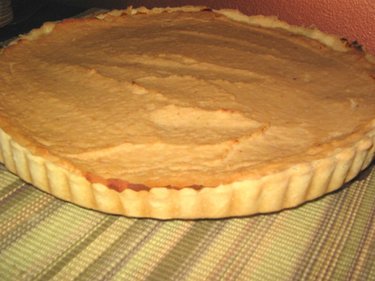 My angelheart Eric had never had quince before I made this tart. I really wanted to give him an introduction to a fruit I really love, and I wanted to use a recipe from my collection of teachers (i.e. a plethora of cookery books). Tamasin Day-Lewis' recipe for Quince Tart from Simply The Best: The Art of Seasonal Cooking, a mouth-watering collection of seasonal recipes punctuated with articles from the weekend edition of Daily Telegraph seemed to fit the bill...
Except I didn't know what a shortcrust pastry was. Tamasin Day-Lewis' instructions were simply to make one with 4oz (113g) organic flour and 2oz (57g) unsalted butter. And then what? Well, I really didn't know. I got the impression that one just combined these two ingredients together until they created a crumble, and then they were to be pressed into the tart pan, but I was not sure. I did a quick search online and found a simple recipe in which water and salt were included, as well as twice the amount of flour and butter. I decided to follow that recipe, but a couple of days later, while reading Hugh Fearnley-Whittingstall's The River Cottage Year, I realised that my initial thoughts were right - he refers to a shortcrust recipe suggested by Elizabeth David - except that I had not considered a drop or two of water to bring the mixture together. Tamasin Day-Lewis seems to admire Elizabeth David, so she probably did mean for me to think about this method. Now I know. But today I give you the recipe I ended up following, which was fine, except I should have added some sugar because the pastry ended up being too savoury for this dessert.
As for the quince themselves, a kind of mousse is made, which I think masks the gorgeous tropical scent of the fruit. It was a nice and fluffy tasting tart, but it did not bring out of the quince their quince-ness.
Quince Tart
(Adapted from Tamasin Day-Lewis' Simply The Best: The Art of Seasonal Cooking)
For the shortcrust pastry:
9oz (255g) flour
4oz (113g) butter
1 egg, chilled
1 pinch salt
1 tablespoon water, chilled
1) Process flour, butter, and salt in a food processor until the mixture looks crumbly.
2) Whisk the egg and water in a bowl until combined, then add to the flour mixture while food processor is running. Process until dough forms large clumps.
3) Turn dough out on to work surface and knead gently to bring together.
4) Form into a disk, wrap in plastic, and refrigerate overnight or for at least two hours.
For the filling:
5 quince, peeled, cored, and cubed
2 tablespoons water
2 tablspoons vanilla superfine sugar (vanilla caster sugar)
2 egg yolks
3 egg whites
2oz (50g) butter
1) Preheat oven to 375 deg. f. (190 deg. c.).
2) Line a 10" (25cm) tart with the shortcrust pastry.
3) Stew quince gently in a covered pan in the water and sugar until tender.
4) Liquidise quince in a food processor, test for sweetness before adding egg yolks, butter, and cream, then give it a quick whirl in the processor. Scrape mixture into a bowl.
5) Whisk the egg whites to stiff peaks in a separate bowl, then fold them into the quince mixture lightly and quickly.
6) Pour the quince mixture over the pastry base.
7) Cook for approximately 35 minutes, until well risen and "airily set". Serve warm.
Next time I make this, and there probably will be another time as quince are still in season, I will poach the quince with their cores in because this is what creates that gorgeous pink hue quince are known for as well as a "jelly"). I will then scoop them out, slice them, and then arrange them in the tart pan to bake. This way, I think I will get that quince-ness I'm after.
Labels: Quince, Tamasin Day-Lewis, Tart